Allbridge fees - Total Bridge and Gas Costs
Allbridge fees depend on the product, transfer amount and selected route. Core applies a 0.1% service fee plus a route-dependent relayer fee. Source-chain gas and any optional destination gas purchase also affect the funds required. Next quotes its own routes, while deprecated Classic used a separate schedule. Estimate the total by separating deductions from the transferred tokens and payments from other wallet balances. A larger destination token amount can reflect fees paid from another wallet balance.
Key takeaway: A destination gas top-up buys a usable token balance, so its purchase amount belongs separately from bridge charges.
Core's Service Fee and Cost Basis
Core combines a percentage service charge with a relayer charge for destination execution. Those components use different inputs, so one percentage does not describe the full transfer cost.
The Transferred Amount
Core's service fee is 0.1% of the transferred amount. This rate applies across CCTP, xReserve and OFT routes. Multiplying the transferred amount by 0.001 gives the service component before other charges. Increasing that amount increases this component proportionally, even when the destination execution cost follows a different pattern.
Deductions Versus Separate Payments
A net-received amount accounts for charges taken from the transferred tokens. Fees paid from another balance remain part of the total cost. Combine those amounts only after expressing them on a consistent valuation basis. Include separately paid source gas, then identify any purchased destination gas as a separate allocation. Counting the same relayer charge inside the quote and again as destination execution gas would overstate the total.
Relayer Charges and Source-Chain Gas
Core's relayer fee funds the transaction that delivers tokens on the destination chain. Destination gas prices and execution costs affect this charge. A different receiving network can therefore change the quoted fee without changing the transfer amount. The sending wallet also pays for its own blockchain transaction. On EVM networks and Tron, any required token-approval transaction adds a separate source-chain network cost. Its confirmation screen shows that network charge, which belongs alongside the bridge quote when estimating the required funds.
Destination execution and destination spending use gas for different purposes. The relayer charge covers delivery; a top-up supplies a recipient balance for later transactions.
Core's Payment Options and Gas Top-Ups
Stablecoins and Source Gas Tokens
Core allows relayer fees and optional extra-gas purchase costs to come from the transferred stablecoin or the source chain's gas token. Stablecoin deductions reduce the token amount that reaches the recipient. Separate payment draws on another balance. The selection changes where the charge comes from; the wallet's own transaction gas remains a distinct cost.
ABR0 and the Relayer Discount
ABR0 payment offers a discount on Core's relayer fee. Core calculates its service fee separately, and the sending blockchain charges its own transaction gas.
Purchased Gas on the Destination
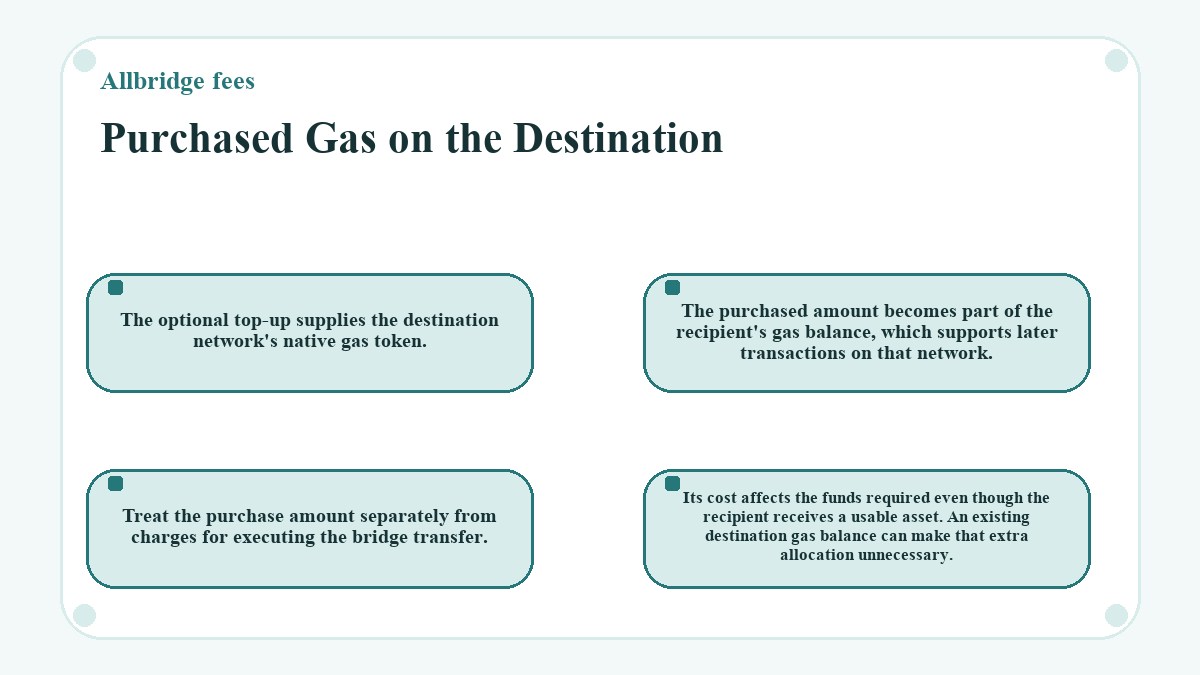
The optional top-up supplies the destination network's native gas token. The purchased amount becomes part of the recipient's gas balance, which supports later transactions on that network. Treat the purchase amount separately from charges for executing the bridge transfer. Its cost affects the funds required even though the recipient receives a usable asset. An existing destination gas balance can make that extra allocation unnecessary.
Core's Quote-to-Delivery Cost Stages
Core can show a larger stablecoin receipt when the relayer fee comes from a separate balance. Compare that setting with stablecoin payment while keeping the route, transfer amount and gas top-up unchanged. The difference identifies a change in the payment source. It does not, by itself, establish a cheaper transfer.
| Transfer Stage | Fee or Amount Relevance | State or Verification |
|---|---|---|
| Route Setup | Amount, asset and network pair determine the quote inputs. | No funds have moved. |
| Fee Options, Wallet Review and Token Approval | Payment token and optional top-up determine deductions. Any required token approval adds a separate source-chain network cost. | The quote and wallet describe intended charges. |
| Source Transaction | The wallet shows source-chain transaction gas. | Submission alone does not establish destination delivery. |
| Source Event Confirmation | The confirmed event identifies the transfer amount. | The route requires evidence of the source burn or lock. |
| Destination Message | Relaying supports destination execution. | The message itself does not move tokens. |
| Destination Transaction | The recipient receives tokens after applicable deductions. | The destination transaction records token delivery. |
| Totals across different payment tokens require a common valuation basis. | ||
Allbridge Fees - Estimate Total Bridge and Gas Costs
- Core's Payment Options and Gas Top-Ups
- Core's Quote-to-Delivery Cost Stages
- Next's Typical Fee and Swap Output
Next's Typical Fee and Swap Output
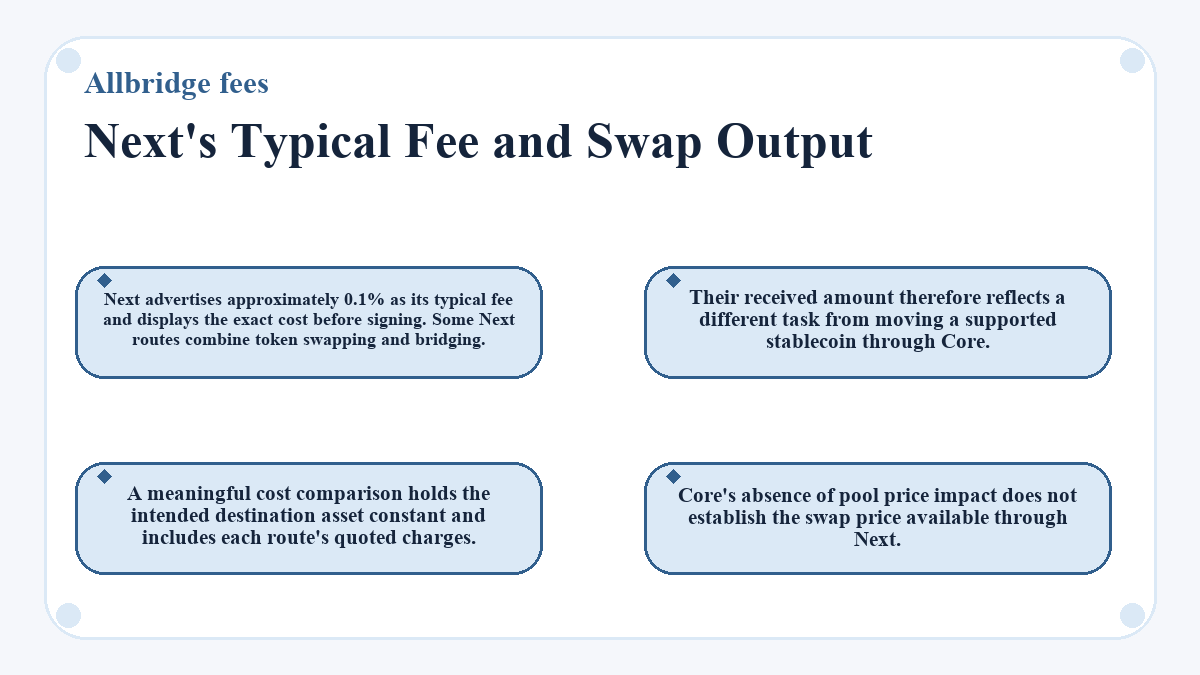
Next advertises approximately 0.1% as its typical fee and displays the exact cost before signing. Some Next routes combine token swapping and bridging. Their received amount therefore reflects a different task from moving a supported stablecoin through Core. A meaningful cost comparison holds the intended destination asset constant and includes each route's quoted charges. Core's absence of pool price impact does not establish the swap price available through Next.
Classic's Legacy Fee Schedule
Classic is deprecated and scheduled to stop in November 2026. Its historical fee schedule belongs to its native and wrapped transfer system, separate from Core's native-transfer pricing.
Source-Chain Rates
Classic's schedule listed a 0.3% bridge fee for Avalanche, BNB Chain, Celo, Fantom, NEAR Protocol, Polygon, Solana and Stellar. Ethereum used a $1 charge, while Stacks and XRP Ledger used 0.1%. The source blockchain determined the scheduled rate, and the transferred token paid the bridge fee. Where Classic supported staking, the sending wallet's xABR share on the source chain determined its fee reduction.
Manual and Delegated Receiving
Classic's manual routes required the user to fund the sending and receiving transactions, except for its separate XRP Ledger receiving flow. On enabled routes, delegated receiving let the bridge execute the destination transaction for a charge taken from the transferred assets. That receiving charge covered destination execution.
Net Receipts, Backing and Retired Pool Fees
Core's liquidity pools ended in July 2026. Legacy pool-fee calculations therefore do not describe its CCTP, xReserve and OFT transfers. Current Core transfers have no liquidity-provider fee or pool price impact. That removes a pool-pricing component, while service and execution charges remain. An xReserve route also distinguishes USDC held in reserve from the USDC-backed stablecoin issued on another blockchain. Its 1:1 backing relationship describes gross token equivalence. It does not make the net amount after route fees equal to the starting amount.
The final comparison needs the destination token, quoted deductions and separately paid charges. Compare the actual destination token representation, especially when a route delivers a USDC-backed asset. If the route swaps assets, changes the fee-payment token or adds a gas top-up, recalculate using that configuration.
Allbridge fees: reader questions
-
How Do I Activate Core's ABR0 Relayer Discount?
- Choose ABR0 as the relayer-fee payment option when creating the Core transfer. The discount accompanies payment in ABR0; holding the token does not replace selecting that option. Check the resulting relayer quote separately from the service fee and the wallet's network charge.
-
Did Classic Charge Its Bridge Fee on Both Send and Receive?
- Classic charged its bridge fee with the Send transaction on the source blockchain. The manual Receive transaction could still require destination gas. Those were separate charges with different purposes, so a receiving-side network cost did not represent a second application of the bridge fee.
-
What Did Classic's $1 delegated-receive Charge Cover?
- Classic's delegated-receive charge covered destination transaction gas when that option was enabled for the route. It took the equivalent of $1 in the transferred asset from the payout. This charge belonged to the optional receiving service, separately from the source-side bridge fee and the user's sending transaction gas.
-
Was There a Separate Classic Receive Fee on XRP Ledger?
- Classic's XRP Ledger receiving flow did not charge a fee for clicking Receive. A recipient without the required token trust line still needed a trust-line creation transaction. That prerequisite was distinct from the receiving service and from the bridge fee collected with the source Send transaction.
-
Can I Still Pay to Create a Core Deposit Address?
- Core's Deposit Addresses are deprecated and no longer available. Their former setup charge paid for one-time on-chain address generation. Old references to that creation fee concern the retired feature, so they do not describe a setup payment required for a current Core transfer.